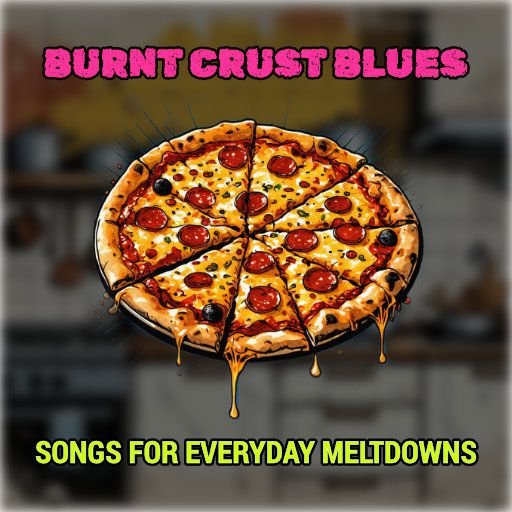
Burnt Crust Blues: When Cookbook Ambition Meets Kitchen Reality
From cookbook confidence to charcoal disc—the story of how we turned pizza-making disaster into a funk-soul-jazz meditation on learning, failure, and what it really takes to master complex skills.
Why This Crisis?
Burnt Crust Blues isn't just another kitchen disaster—it's a metaphor for taking on complexity and failing spectacularly. Unlike burnt toast (simple routine gone wrong), this is ambition meeting reality. You opened a cookbook. You measured flour. You followed instructions. You attempted something that requires technique, timing, and judgment. And you still produced a charcoal disc. Why? Because following a recipe doesn't make you a cook. Reading sheet music doesn't make you a musician. Instructions are necessary but insufficient. Practice makes perfect. Failure teaches. The burnt crust is your tuition payment.
This crisis matters because it captures that universal experience of trying something more complex than you're ready for—of thinking instructions will carry you, of discovering that mastery requires dedication beyond following steps. There's humor in the disaster (flour everywhere, cheese turned to stone), but there's also genuine frustration and disappointment. The ambiguous tone respects both: you can laugh at yourself and acknowledge the real effort you put in. You can mourn the wasted ingredients and recognize the learning opportunity. The crisis is both funny and meaningful, light and layered.
The Multi-Genre Formula
Burnt Crust Blues blends four distinct genres into a cohesive sonic palette, each contributing to the complexity metaphor:
Funk as Discipline: Tight basslines, syncopated rhythms, locked-in groove at 81 BPM. Funk demands precision—every note in the pocket, every rest intentional. The groove represents the structure of a recipe: follow the steps, keep the rhythm, maintain the discipline. But discipline alone isn't enough.
Soul as Feeling: Warm horn arrangements, expressive vocal phrasing, emotional honesty in delivery. Soul brings feeling to the technique—the "why" behind the "how." You don't just follow a recipe mechanically; you develop intuition for when the dough feels right, when the crust looks ready. Soul is the judgment that comes with practice.
Jazz as Improvisation: Sophisticated chord progressions, unexpected harmonic movement, space for interpretation. Jazz teaches you that rules are guidelines, not laws. A great cook learns when to deviate from the recipe, when to trust instinct over instruction. Jazz is the creativity born from mastery.
Hip-Hop as Rhythm: Programmed drums, rhythmic vocal delivery, beat-driven momentum. Hip-hop represents the confidence of youth—that peppy energy that says "I can do this, no problem." The young male vocalist embodies this optimism even as the pizza burns. There's swagger in the attempt, even if the outcome disappoints.
This four-genre blend creates sonic complexity that mirrors the complexity of the cooking challenge. It's not simple blues or straightforward funk—it's layered, sophisticated, ambiguous. Just like making pizza from scratch.
The Meta-Commentary
Here's where it gets interesting: Burnt Crust Blues contains a self-aware commentary about its own existence. The metaphor extends beyond cooking to any skill requiring dedication—including music. Learning to play a real instrument takes years of practice, countless hours of failure, persistence through frustration. You can't just press a button and become a musician. But you can press a button and generate music.
CrisisKaraoke uses AI to create these tracks. We're not hiding that fact—we embrace it in the "AI Discussion" sections of every blog post. But here's the tension: this track is simultaneously using AI music generation while commenting on the gap between instructions and mastery, between pushing a button and developing skill. It's critique and complicity. It's satire and sincerity. It's... ambiguous.
Is the burnt pizza a metaphor for AI-generated music—something that followed the instructions but lacks the soul of handcrafted work? Or is it a metaphor for any first attempt at complexity, reminding us that everyone starts somewhere, that failure is part of learning, that even AI-assisted creation requires judgment and iteration? The ambiguous tone lets you hold both readings simultaneously. The light humor says "don't take this too seriously," while the genuine disappointment says "but also, maybe do."
This is the magic of ambiguous tone: it creates space for multiple interpretations, invites reflection without forcing conclusions, respects both the comedy and the complexity. You're allowed to enjoy the funk groove and think about what it means that an AI can approximate musicianship while you burn dinner attempting something far simpler.
The Songwriting Structure
Verse 1: The Setup "Sunrise creepin', coffee's cold / Got a hunger story gotta be told / Flour on the counter, cheese in a pile / Thought I'd bake a masterpiece, stay a while." The scene is domestic, relatable, hopeful. Morning hunger drives ambition. The cookbook appears: "Perfect Pizza," page seventy-three. You've got confidence, ingredients, instructions. "Oh, the ambition, burnin' so bright / Ignorin' all the warning signs, with all of my might." Foreshadowing the literal burning to come, but also highlighting that cocky optimism—you've got this, right?
Chorus: The Refrain "Burnt crust blues, yeah, they got a hold / This culinary disaster, a story untold / Taste of ash and disappointment, a bitter goodbye / My pizza dreams went up in smoke, reachin' for the sky." Three emotional beats: (1) the blues have you—this isn't just a mistake, it's a mood; (2) ash taste and disappointment—the sensory and emotional consequences; (3) dreams in smoke—the gap between aspiration and outcome. The chorus is catchy enough to be memorable, earnest enough to feel real, playful enough to avoid melodrama. Ambiguous tone in action.
Verse 2: The Process "Mixed the dough, felt so strong / Like a kitchen wizard, couldn't go wrong." Peak confidence. You're following the steps, feeling competent. "Sauce went on, a crimson tide / Pepperoni circles, nowhere to hide / Into the oven, heat set high / Watched it bubble, with a hopeful eye." Everything seems fine. You're watching, hoping, waiting. "Five long minutes, then ten, then more / An aroma risin', never smelled before." Uh oh. That's not normal pizza smell. That's disaster smell.
Bridge: The Reveal "Pulled it out, a charcoal disc / Cracked and twisted, takin' every risk / Cheese was melted, turned to stone / My stomach rumbled, felt so alone / One bite taken, a crunch and a cough / My culinary adventure, went right off." The language is vivid: charcoal disc, cheese stone, crunch and cough. You still tried to eat it—that brave (stupid?) bite. The adventure didn't just fail; it "went right off"—British slang for going badly wrong. The isolation of failure: stomach rumbling, standing alone in the kitchen with your inedible creation.
Outro: The Resolution "Yeah, burnt crust blues, gonna sing 'em all night / Next time I'm orderin', gonna do it right." Acceptance with a wink. You're not giving up on pizza—just admitting defeat on homemade attempts. "Next time I'm orderin'" is both funny (retreat to takeout) and practical (know your limits). The light humor saves it from being too heavy, but the genuine disappointment (singing the blues all night) keeps it from being trivially comedic. Again: ambiguous.
Why This Crisis Matters
Complexity Requires More Than Instructions: Recipes, tutorials, sheet music, manuals—they're starting points, not guarantees. Mastery comes from practice, failure, iteration, intuition developed over time. Burnt Crust Blues validates the experience of trying something ambitious and failing despite following the rules. It's not about being stupid or careless; it's about the gap between knowing steps and developing skill.
Failure Is Part of Learning: The charcoal disc is expensive (wasted ingredients, wasted time), frustrating (hunger still unmet), and humbling (you thought you had this). But it's also educational. You learned what burning smells like, what happens when oven temp is too high or timing is off, what "watching carefully" actually requires. Next time—if there is a next time—you'll know more. The burnt crust is tuition.
Ambition Deserves Respect: The track doesn't mock you for trying to make pizza from scratch. The peppy vocals and light humor don't undercut the genuine effort. You could have ordered takeout from the start, but you tried to create something. That matters. The ambiguous tone holds space for both the comedy of the disaster and the dignity of the attempt. You're allowed to laugh at yourself and still feel proud that you tried something complex.
The Meta-Reflection Invites Thought: By including that subtle commentary about instructions versus practice, about pushing buttons versus developing skills, the track opens conversation about what mastery means in an age of automation and AI assistance. It doesn't provide answers—it's ambiguous, remember—but it asks questions. What does it mean to "make" something? When is using tools cheating versus leveraging? How do we balance efficiency with craft? The burnt crust becomes a Rorschach test for your own values around skill, effort, and authenticity.
The AI Discussion
Full transparency: this track was created using AI voice generation and AI-assisted composition tools. The irony is not lost on us. We've made a song about the gap between following instructions and developing mastery, and we've made it by following AI prompts rather than learning to play instruments or produce traditionally.
But here's the thing: the metaphor still holds. Creating this track required iteration, judgment calls, understanding of genre conventions, lyrical choices, production decisions. We didn't just press one button and get a finished song. We experimented, refined, adjusted. We brought human curation to AI generation. Does that make us "kitchen wizards" or are we just following a different kind of recipe?
The ambiguous tone of Burnt Crust Blues lets us sit with that tension. We're not claiming AI music is equivalent to traditional musicianship—obviously learning an instrument, writing arrangements by hand, recording live takes requires a depth of skill we don't possess. But we're also not saying AI creation is worthless or talentless. It's a tool, like a cookbook. What you do with it, how you refine it, what you bring to it—that matters.
The young male peppy vocals bring energy and optimism to a disaster story. The multi-genre blend requires understanding how funk, soul, jazz, and hip-hop elements interact. The ambiguous tone demands careful balancing of humor and sincerity. These are creative decisions, not automatic outputs. And still—inevitably—some attempts burn. Some tracks don't work. Some lyrics fall flat. The burnt crust metaphor applies to AI-assisted creation too.
Join the Crisis
We invite you to explore your own burnt crust blues:
- Share Your Kitchen Disasters: TikTok #BurntCrustBlues with photos of your culinary catastrophes—bonus points for following recipes that still went wrong
- The Ambition Challenge: Attempt a complex recipe you've never tried before, document the process (success or failure), share what you learned
- Recipe vs Reality Meme: Post side-by-side of cookbook photo vs your actual result
- The Meta-Reflection: What skills are you currently learning? Where's the gap between instruction and mastery in your life? Share your practice journey
The beauty of this crisis is that everyone has burned something while trying to level up their skills. Everyone has followed instructions and still failed. Everyone has felt that gap between aspiration and outcome. Your burnt crust is valid, your effort matters, and your learning process deserves respect—even if dinner ended up inedible.
Why It Works
The Multi-Genre Blend Matches the Complexity: Four genres working together = sophisticated challenge requiring multiple skills. You're not just following one simple instruction; you're balancing technique (funk), feeling (soul), improvisation (jazz), and confidence (hip-hop). The sound mirrors the crisis.
The Ambiguous Tone Respects Nuance: Not everything is pure satire or pure sincerity. Real life is messy, contradictory, layered. You can laugh at your burnt pizza and still feel genuinely disappointed. You can appreciate the humor and still respect the effort. Ambiguous tone creates space for adult complexity.
The Meta-Commentary Invites Reflection: By layering in that subtle parallel to learning music (or using AI music tools), the track becomes more than just a kitchen disaster story. It's a meditation on mastery, shortcuts, authenticity, and what it means to truly learn something. The burnt crust is a mirror.
The Young Peppy Vocals Keep Energy High: Even in disaster, there's vitality. The vocalist doesn't wallow—he narrates with energy, keeps the groove moving, maintains optimism despite the outcome. That resilience matters. You burned the pizza, but you didn't burn your spirit.
F Major at 81 BPM Balances Brightness and Reflection: Major key prevents it from becoming too heavy or bluesy (despite "blues" in the title). Mid-tempo groove gives space for lyrical storytelling and genre interplay without rushing. It's contemplative without being slow, energetic without being frenetic. The tempo matches the pacing of cooking—methodical, hopeful, building to that moment of reveal.
The real crisis isn't the burnt pizza. It's needing four genres to process one kitchen failure and still not learning to check the oven timer.